Selected work · 04
LUNAR
ROVER.
A lunar mission concept shaped by orbital constraints, system tradeoffs, and the discipline of turning exploration into an executable architecture.
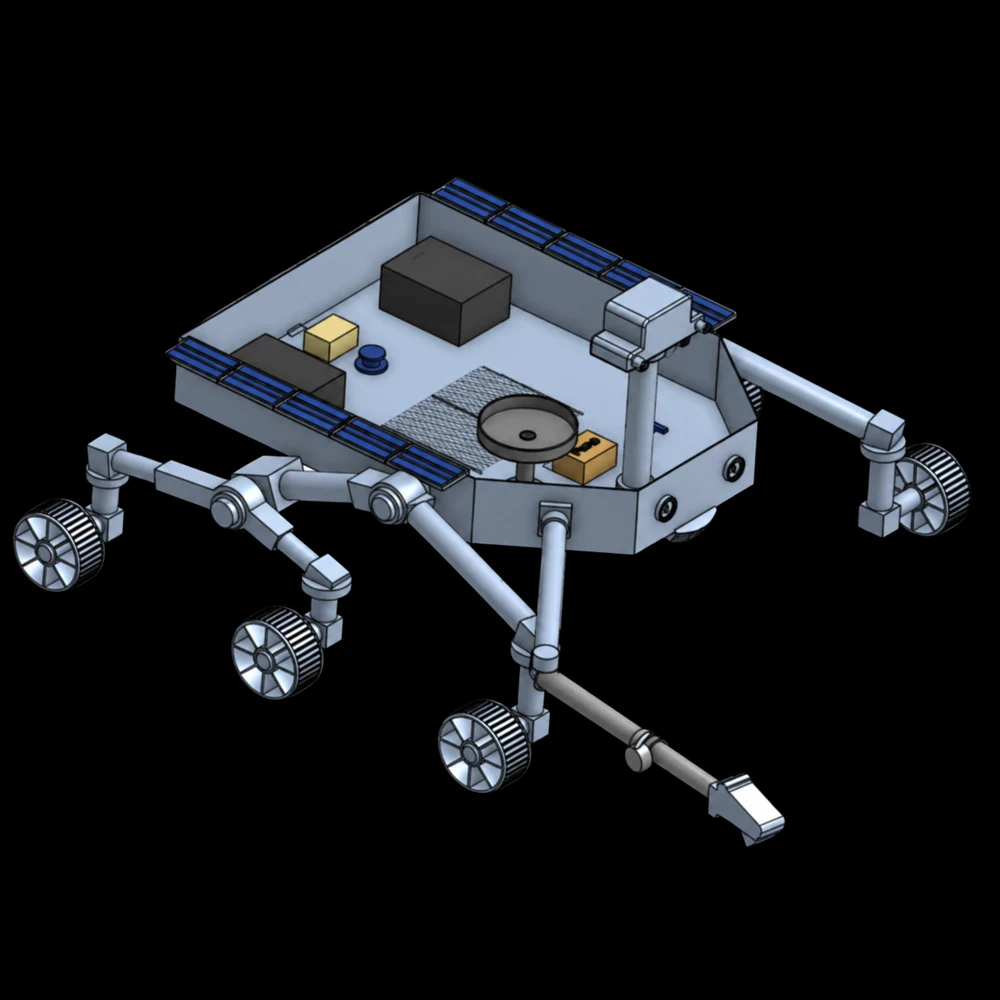
- Goal
- Develop a lunar rover mission concept for the Mare Tranquillitatis Pit.
- My contribution
- Lead systems/project manager and mechanical engineering; 14-person team.
- Result
- Delivered a 160+ page Preliminary Design Review.
- Org
- NASA L'SPACE Academy · Arizona
- Role
- Project Manager / Mechanical Engineer
- Team
- 14-person team
- Timeline
- Fall 2024
- Focus
- Lunar rover · Mission architecture · Risk · Subsystems
Images & documentation
Inside the project.
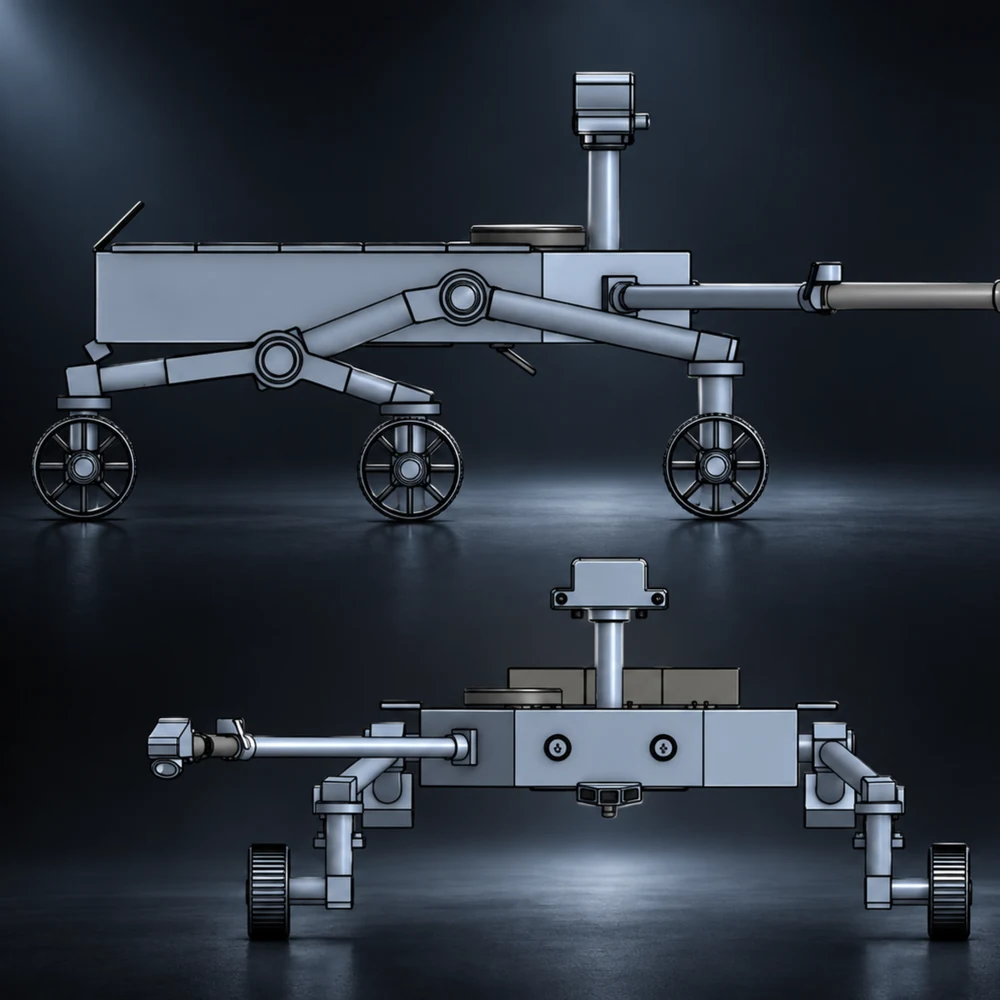


Constraints
The mechanical mass budget was ≤180 kg, including ≤70 kg chassis and ≤30 kg suspension allocations. The stowed envelope was 2.0 × 1.5 × 1.5 m, with a traverse-speed limit of 0.15 mph. These are design requirements, not measured rover performance.
Mobility trade study
I compared rigid and compliant wheels, tread geometry, rocker-bogie pivot placement, and regolith interaction. More wheel-ground contact area can reduce ground pressure and sinkage; larger wheels improve obstacle clearance but increase required axle torque for the same tractive force.
The baseline used a six-wheel rocker-bogie configuration, a 2000-series aluminum chassis, and a NiTi superelastic tire concept. Those choices balanced passive articulation, recoverable deformation, manufacturing, mass, and packaging.
Systems engineering
I converted science objectives into requirements, interface definitions, traceability, and verification criteria. Mechanical design had to accommodate the robotic arm, instruments, power, thermal control, and terrain sensing while preserving clearance and wheel contact.
Review outcome & limits
The team progressed through MCR, SRR, MDR, and PDR. The resulting package covered ConOps, architecture, interfaces, science instruments, budgets, FMEA, risk, schedule, cost, and verification planning.
This work reached preliminary design review. The CAD and calculations document a mission concept; physical regolith testing, environmental qualification, and flight validation are outside the demonstrated outcome.
Contributors
Skills
Project record: Engineering portfolio, pp. 6–7
Explore more of the work.
← Back to Selected Builds