SafeByte — prototype report
Joint report by Taein Kang and Vedarsh Mishra. A 24-hour prototype; intended capabilities and future actions are source claims, not validated dietary-safety performance.
SafeBite Dietary Bracelet Report
Taein Kang & Vedarsh Mishra
For the Boston College Make-a-thon’s Shea Center for Entrepreneurship Track
Intent and Inspiration
Organizing a diet that keeps people healthy is a troubling task in everyday life and is all the more complicated when coupled with dietary restrictions. After being inspired by 1) the Shea Center’s desire to aid individuals through innovation and technology, and 2) real world products that seamlessly improve a person’s well being and health tracking such as fitbits and smart watches, our goal was to create a low-cost, wearable solution that utilizes artificial intelligence and publicly available databases to quickly and accurately identify nutritional statements in accordance with a user's dietary needs.
Process
By the end of the Make-a-thon’s 24 hour time constraint, we wound up with a prototype bracelet that we envision could allow users to effortlessly scan food items and barcodes and be prompted if they don’t adhere to one’s needs. The prototype came in three parts that we developed sequentially:
Wearable Hardware- The physical components of this device feature a 3D printed, adjustable bracelet with a placeholder for the camera, which is physically attached to a Raspberry Pi computer.
Software- The images captured by the camera is sent by the Raspberry Pi to the internet, where they are interpreted by a large language model (LLM) that searches databases for nutritional information.
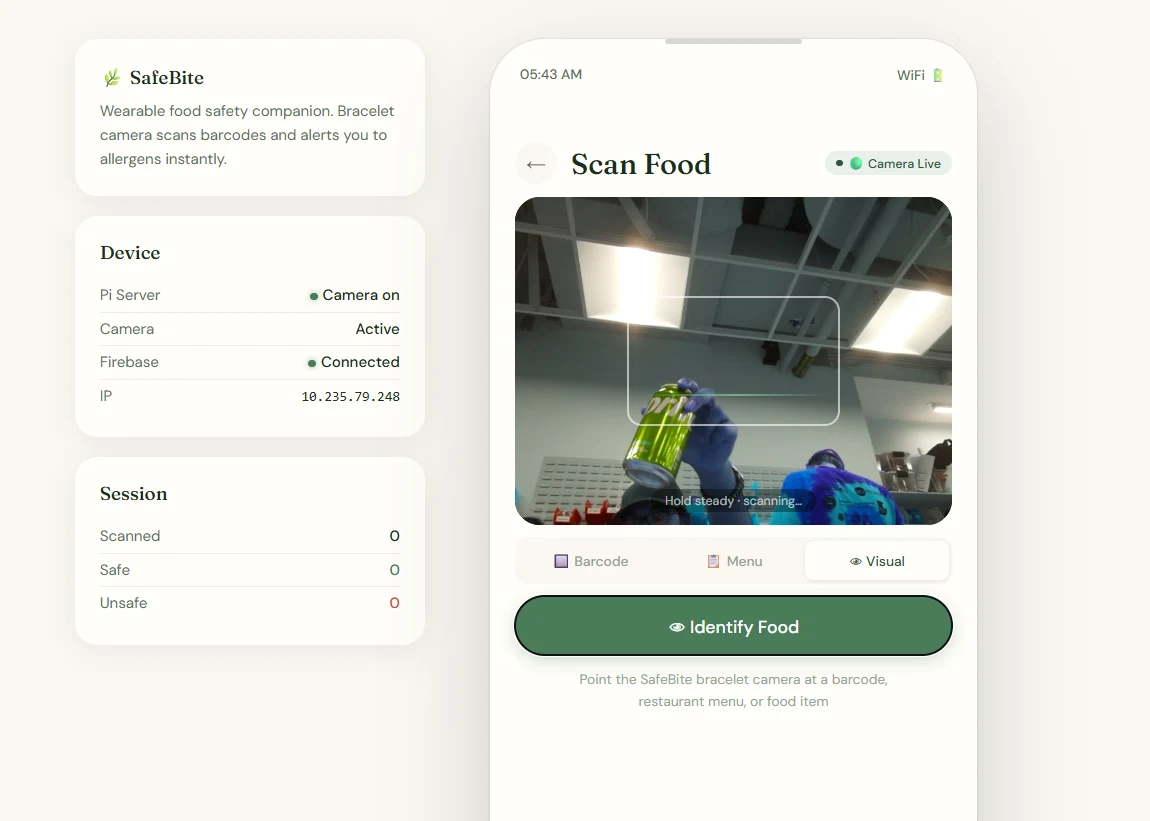
User Interface- To tie the prototype together with the user, we developed a website that allows the user to interact with the physical device and receive a response on the information of the food they are analyzing.
Current Specs and Cost Estimate
3D Bracelet Filament- $2-3 per unit, heavily based on amount necessary for different sizes
Camera Module- $6-25 per unit for the model we used as the company we sourced from (Raspberry Pi) offers cameras of similar image quality in this range.
Raspberry Pi computer- $20 per unit
Total Cost Estimate: $28-48 per unit
Future Actions
If we were to continue our project in adherence to the Shea Center’s pillars of impact, sustainability and scalability, we would act on three distinct plans of improvement
Cost reduction- decreasing costs with little to no negative impact on the effectiveness through material exploration, for example a Raspberry Pi is an advanced, all-purpose computer while a simpler one with a bluetooth connection could cut down prices astronomically.
Scalability- scale to larger audiences with appropriate actions to address both hardware and software. For example, due to the versatility of the bracelet parts, injection molding can be used to reduce operating costs compared to 3D printing, and the prices of cameras and computers can be reduced significantly. Cloud-based software engineering can reduce RAM usage when using it. Finally, direct-to-consumer distribution as well as partnerships with health navigation companies can increase the presence of the product.
Capability and Diversity- add additional features that will address more diverse audiences, all while at a more efficient pace. Improving the machine learning algorithms will allow for more personalization of the nutritional statements and alerts for different people and lifestyles.